Sunday, 2 July 2017

VR Escape the Room Trilogy (Verdict: Avoid)


Hello VR Followers, for today's review: The VR Escape the Room Trilogy.

VR Escape the Room Trilogy.


These 3 games aren't a trilogy in terms of any continuity, only that they are 3 escape room games from the same developer that likely use the same engine. At the moment you can buy them in a bundle with 57% off in the Steam sale, which peaked my interest enough to take a chance on them.

To explain to the uninitiated, escape rooms are where you are put into a locked room, and in order to escape you have to solve puzzles that build up to letting you open the exit, whether it is finding keys, numbers to a keypad code, whatever.

In fact escape rooms are a new trend in real life as well. I haven't been to one in the UK yet, but I have been to 2 in the US and 1 in Israel and I can tell you the general experience is very similar, it's just the setting and puzzles are different. I do quite like escape rooms because they appeal to the puzzle solver in me, so this is another reason I was interested in these games.

A key difference to real life vs VR escape rooms is that in real life you tend to be a team locked in the room, whereas in VR you are on your lonesome.

A Bad Experience

Don't drop a book on the floor, you won't be able to pick it up again! WTF?

Unfortunately, this game series did not work well for me. I only actually played The Cabin: VR Escape the Room and then I asked for a refund. I will tell you why.

If you look in the Store Page for this game, you will see the words "This VR game requires a play area of at least 2.1m x 1.8m." My play area is 2.3m by 2.2m, should I should be fine, right?

Wrong. The game operates by relying completely on room scale to let you move around the VR space, there is no other method of moving in the game except to physically move yourself. This is what it is important that you have sufficient space.

The problem is, the game does not render the VR world properly into your space. For me it was off centre, and the result was that one of the walls was rendered about 30cm past my real wall. I managed to play the game for a bit, but then found a button on this wall that I needed to press, and I couldn't because my real wall stopped me from getting there.

So I couldn't continue, stopped dead by a technical issue.

Another thing I found is that the VR world's floor was rendered about 20cm below my real floor. The result of that is that if you drop books on the floor, you can't pick them up.

I say this to the developers, "Come on guys!" If you are going to create a game that relies on room scale then you can at least make sure the game world maps properly onto the real world, otherwise
what is the point?

So it is a thumbs down and a recommendation on me to avoid this series of games. I don't care if the bundle is 57% off, if the game is technically unplayable it could be £1 for all I care. Luckily, Steam gave me a refund (good ol' Steam, they have never done me wrong).

I've been on Steam since Half Life 2 came out and now I've only ever claimed 2 refunds. One for The Solus Project and now one for this game bundle. This shows you what a crap shoot the VR game industry is right now.

The Solus Project Review (Verdict: Avoid)

Hi everyone,

The first game I am reviewing from my Steam bargain list is The Solus Project. Despite what I said in my Steam sale post about not wanting to burn through the games quick in a rush to review them, I've spent 3 hours on The Solus Project and I'm not going to play it any more. The reason for this is a game breaking bug which has no place being in any commercial release. Skip to the section titled "The Game Breaker" if you want to jump straight to finding out what it is, but I strongly recommend steering clear of this game until you see this bug is fixed (which based on an Internet search demonstrating this problem going back over a year, is unlikely to be any time soon).


The Premise


The background for The Solus Project is that Earth has been destroyed by a wandering rogue star. Scientists saw it coming a couple of decades ahead of the actual event and so life vessels were built and a fraction of the population managed to escape to regroup near Pluto. Exploratory vessels have been sent into deep space in order to find new planet to colonise.

However, after years of travel disaster strikes (of course). As you are approaching your destination planet, your ship is destroyed and you manage to escape and crash land in a life pod. This is where the game starts, you have to learn how to survive and try to contact your people to let them know what happened.

If the crash land and survive premise sounds a bit familiar, this is because it's basically the same as Subnautica. Different world and different type of game (diving underwater vs on land) but yeah, it seems this is a bit of a cliché. The VR market is full of them!

Playing the Game.


The game babysits you through the first hour to form a tutorial on how to play. First steps sound very textbook. Find shelter, food and water, make fire for heat and light.


The weather is one of the highlights of the game world - extremely threatening

Shelter is very important in this game because the planet does have extreme weather. Rains come in with only the warning of rolling clouds from the horizon and typically feature dangerous lightning, tornados are also too common and you even get meteor showers. The weather effects in The Solus Project are very well done and carry a real sense of concern. You will find yourself strongly motivated to stop what you are doing and find some shelter nearby to wait out the storm. As well as food and drink, your character has to sleep to survive. Storms can take hours of in-game time to pass so what else is there to do but catch forty winks while you wait for it to blow over?

Once you finish the first survival steps the game prods you into exploring the area, trying to find survivors and work out how you can communicate to your people off-planet. After some time spent being in this mindset, you'll quickly realise that survival is in fact largely trivial in this game. Food and water sources are plentiful, at least in the first few hours, and your biggest problem is managing the very small inventory space you have when you start. I guess it is realistic not to be able to hold much, and you can upgrade your storage by finding backpacks in wrecked bits of ship and life pods. But after going so heavy on the survival element and making you think you need to horde food and water, you realise that actually travelling light is the best option. All you need to do is run for cover when the weather comes in and, hey, you're surviving just fine on this supposedly hostile planet.

The game prods you into your first few discoveries, you find another person in their camp and see they were also trying to build a way of communicating off planet and then the game helps you with getting the first few parts. Then all the help stops suddenly.

As someone who doesn't necessarily need to be hand-held through open world games, I explored for the next hour and had a very good time before I saved and finished my gaming session.


Graphics and Sound


The day and night skies are very pretty

I always start with sound in these sections because it seems easier to review 😁. The sound in The Solus Project is very atmospheric. The high points are when you are suffering the extreme weather, you can hear the wind whipping around you, rain falling hard, meteorites striking all around you. Other than the weather however, sound is relegated to plodding steps, the bing of some piece of tech nearby, the sound of fire on your old-school torch and the movement of wind.

The graphics in the game are quite detailed and successfully immerse you into this somewhat barren landscape. However, much like sounds outside the storms, none of it is particularly memorable in the first few hours. Landscapes are convincing if dull, the dark sky at night is very pretty with stars and during the day quite beautiful with the alien planets close up in the sky. The skies are well done, but you don't spend much time looking up in this game so you soon forget the sky. Landscapes are barren, caves dull. Again, I guess this is realistic, but it's not very exciting. Overall, however, you do have to say the overall immersion is of a very high standard.

The game engine seems to run well. I don't recall much in the way of stuttering, no SteamVR loading screens randomly popping in, load times are deliberate and only occuring during area transitions, the game runs fine, except....


The Game Breaker


Having played for 3 hours I decided to save and finish my session. The game focusses on realism and I was having enough fun to want to keep exploring and see what happens next. So I was looking forward to starting up again the next day.

The next day, I loaded the savegame, and appear 20 feet under ground level and I start falling away from the game world. Hoping this is a one-off, I reloaded again, and the same thing happened. I reloaded a third time just in case, same thing again.

So basically my save is corrupted and I can't continue.

The game has an autosave feature so I tried that. The save loads fine, but the autosave was during the last area transition, and I probably played 1 to 1.5 hours and completed a whole bunch of tasks before I manually saved, so that is not good enough.

The game has a device which allows you to teleport short distances, so I wondered if I could use that to reload and quickly teleport back above ground again to salvage my savegame. I tried maybe 20 times, but the device does not behave predictably in this unpredictable situation, so it is no good.

So I uninstalled the game and I won't be going back for now.

There is absolutely no excuse for this kind of ridiculous save-breaking game-breaking bug in a game which is £14.99 at full price. This save game corrupted at the end of my first play session. If it is going to happen that soon in the game then it could be a common bug for all I know, and I'm not going to risk my game time with that. Indeed, a very quick search on Google brings up multiple results with other players having the same problem, results going back more than a year.

This is exactly what I am talking about when I say you take a risk every time you buy an Indie VR game. I can't say I have ever come across such a heinous and ridiculous save corruption bug before. Even in Bethesda games like Fallout and The Elder Scrolls series which have been glitchy in their time (particularly Fallout 3 and Fallout: New Vegas), the game developers cover this by giving you multiple regular autosaves so although it can be annoying, the worst that can happen is you lose 30 minutes of gameplay.

This is why I'm taking the opportunity during the Steam sales to buy these games. I would have been absolutely raging if I'd spent £14.99 on this only for it to crap out after 3 hours. As it stands, at £7.49, I'm still going to try for my first ever Steam refund, I'm not content to patiently wait potentially another year to see if they'll fix this problem.


Verdict


I am disgusted with such an awful game-breaking bug. A very quick search on Google shows that this is a fairly common problem that has been going on for at least a year, and it still isn't fixed.

I have to recommend to everyone to avoid buying this game, discounted or not!

Avoid!

Saturday, 24 June 2017

Subnautica Review (Verdict: Excellent)

Hello folks,

Those of you who read my blog (thank you) will know that I've said the next sentence time and time again: I'm very wary of spending full game price on VR games, because the quality is so varying.

Prior to the Steam Summer Sale (see previous post), I only purchased one VR game. I did this after having pretty much exhausted the most obvious free games and experiences on Steam, and only after a lot of research.

The game I bought was Subnautica and I paid £14.99 for it. It is currently 50% discounted on Steam at the moment, so until July 5th you can buy it for £7.49.

Technically Subnautica is in "Early Access" release, which means it is not a finished game. However, as you can see in the Subnautica Blog, it's been in development for a few years already, so even though there's still a lot of polish that can be added, it is already a great in-depth experience that you can spend many many hours enjoying and exploring.

So What's Subnautica About?


The basic premise of the game is that your space ship has crashed landed whilst you were in the vicinity of a water planet. Luckily, your life pod ejected before impact and saved your life, managing to absorb it's own landing and successfully inflate the bouyancy aids. This is where you begin the game, you have literally just landed and you need to start working out where you are and what you need to do to keep yourself alive.

As soon as you venture outside, you realise that water effectively covers 100% of the planet surface and therefore all life is in the sea, returning back inside your life pod and checking the replicator, you can start to learn what resources you need to gather to construct basic survival tools.

The game has various modes to suit the type of gamer, but in the default Survival mode, you need to eat and drink to stay alive, and also you need to breathe, which as this game is mostly underwater, is probably the biggest challenge out of eat/sleep/breathe to manage.

How the Game Plays


Food and water, whilst being an important factor in survival mode, is not such a great task to manage. As long as you keep a check on your levels and make sure you keep a stock of water specifically, you don't really need to worry too much about staying on top of these. Before you set out for a long expedition, as long as you've fed and watered yourself and you keep a small stock in your inventory, you'll be fine.

It's really oxygen that defines how you play this game. To start off with, you can hold your breath for 45 seconds, which really means you begin by swimming in the shallows and the range of your exploration is taking expeditionary dives underwater to explore specific areas of the sea bed or to gather resources. Pretty soon you can craft a basic oxygen tank, which whilst only giving you an extra 30 seconds, makes a big difference to your underwater scuba diving. The next big initial step is that it is not too long before you can build a small submarine vessel. The vessel produces oxygen for you, which means now you can go deeper and explore much more, and only need to worry about your oxygen level when you leave your craft to gather some resources or enter a confined space.

The limitations of oxygen and this slow-but-steady development of your abilities really define how the game works overall. Initially you are presented with a very limiting factor, by exploration and trial-and-error you can understand how to overcome that challenge, then that part becomes easy and you move onto the next task. Thus, you can start to explore more and more of the world and get further into the game.

The other main method of advancement is technology. Using a tool you create fairly early in the game, you can start to gather blueprints based on stuff you find lying around when you explore, and this lets you build better and bigger things.


The Subnautica World


The Subnautica world is a beautiful and exciting place to explore in VR. The world is made up of different biomes where different flora and fauna live and there are several times when you get a new sense of wonder at new creatures you find as you explore further and deeper. I won't give up further details on this because it will spoil the game, but there have been several times when I have stopped what I was doing and just swam around a new creature in amazement because I'd never seen anything like it before in the game.

There is also a genuine sense of danger in exploring the seas, something that I think VR enhances. When diving into the deeper spaces, concern for oxygen is genuine. That cave over there that looks like it twists and turns, how far do you explore before you worry about if you can get back in time? Also, not all the sea life is friendly and there are creatures in this game that will either have you instantly concerned if you spot them first, or will put you into a panic if they manage to creep up on you.

Your space ship was large and other life pods were ejected. You get a helping hand in the first hours of the game as your lifepod computer picks up on signals from the surrounding area and invites you to explore them. It's possible that there are some other survivors and even if there are not, there might be some tech you can scavenge to help your own situation. Plus, the space ship crash landed in shallows and is always in view, perhaps you can visit what's left of the hull and find out why it crashed.

There is a basic plot to the game, which you are gently nudged along in the early parts of the game thanks to the signals your lifepod picks up, but really you are never pushed to follow it. Furthermore, after you receive a bunch they just stop, and then you are really left up to your own devices. Personally, although I like being able to explore freely and not be confined to the story, I can't help but feeling it is a bit too light in Subnautica. Exploring or not, I always like to know what I need to do next to get further along in the story, and after a while you are really left just to work it out yourself.

Graphics and Sound


The sound in Subnautica is spot on. Various creatures have their own sounds and the audio cues in the game are sometimes even more important than seeing things. In particular, hearing the sound of a predator will have you checking around so you are sure you know what it is doing. Also, the rush of water around your ears when you dive underwater really makes you feel like you are submerging yourself thanks to how the world around you genuinely sounds like you are now hearing it through water. Overall the sound effects and music give a very immersive feeling of really being in the world.

As I said before, Subnautica is undeniably beautiful. However, this is sometimes thanks to the overall immersion rather than the technical quality of the graphics. Sea life tends to always be rendered well and moving realistically, but distance pop-in is a real problem. The Length of Distance view in this game is actually quite short, and not only will you see things popping into view all the time, but sometimes you need to more closely explore an area just so you are close enough to see what you are actually looking for. It's an issue but one that can be lived with.

The other major issue with the graphics is that this game is quite unoptimised. I don't have a beefy VR rig, in fact mine is technically entry level, but nonetheless, I don't typically have too many issues with frame rates in games. With Subnautica, however, frame rates do chug all too often, and not always with any apparent good reason like there's a lot going on. In the worst cases, you can see the SteamVR busy/loading graphic pop up and really I think there is no space for this to be happening in any "proper" VR game. I suspect this is the main factor with the game being in early access. The graphics are beautiful, but the game engine needs a lot of polish. Still, I find I can easily look past these issues and stay genuinely immersed.

Overall


Despite any issues with the graphics and the plot, I heartily recommend Subnautica to VR headset owners. There is a full scale world to explore, the graphics and sound are beautiful even if the game engine needs polish, and I especially like the underwater survival element of the game.

I bought this game at full price and having probably spent 20-30 hours on it already (and feeling like I am nowhere near the end), it is definitely value for money. The game being early access might put some folks off, and it did me originally, but the developers don't give any signs as to when they'll make the 1.0 release and really I think you are doing yourself a disservice if you hold off buying Subnautica just for that reason.

Steam Summer Sale Now On


Full Disclosure: I am not affiliated with Steam in any way, nor do I gain any commission from anything in this blog post, I am merely a happy customer!

Attention all HTC Vive and Oculus Rift owners, the Steam Summer sale is now on!

If you've looked out for previous sales, then you will be well aware of the tradition of picking up multiple games for bargain prices, only to ever play about 25% of what you bought!

Well, if you are like me and you don't normally like to pay full game prices for VR experiences, which can either be short or so-so in quality, then this Summer Sale also means something else, the opportunity to take a chance on some VR games without worrying about wasting too much money on games you end up not liking!

In just the first couple of days I have already picked up the following.

GameOriginal PriceDiscountSale PriceSaving
Monstrum£11.9975%£2.99£9.00
The Solus Project£14.9950%£7.49£7.50
Dead Secret£10.9960%£4.39£6.60
Twisted Arrow£14.9975%£3.74£11.25
Carnival Games® VR£15.9975%£3.99£12.00
Arcade Saga£14.9975%£3.74£11.25
Please, Don't Touch Anything 3D£10.9960%£4.39£6.60
Blue Effect VR£10.9950%£5.49£5.50
Total£105.9266%£36.22£69.70


You can pick up some great VR bargains in the sale!

As you can see, the Steam Sales are really the way to build up your VR library whilst minimising your risk. I don't mind paying a good price for a game I genuinely enjoy, but the trouble with the VR market is that it is really still dominated by Indie games developers and, to be brutally honest, there are a lot of short, boring, technically poor and/or "early access" games out there.

I don't mind taking a punt on a VR game for £3.99. At that price, if it turns out to be a bad game, it's only a few quid, whereas if I'd spent £16 on it I'd be more upset. Plus, this is a great chance for me to get some games I can review for my blog, for your pleasure of course! 😀

I considered burning through my newly acquired list of VR games, to give each a couple of hours play and have a chance to review them for you guys so you still had a chance to pick them up in the sale. But, upon reflection, I thought the trouble with that is that some games can seem really fun for the first couple of hours, then you discover that the rest of the game is pretty much the same (like No Man's Sky, a huge disappointment), so I'm not going to do that. If you want to take advantage of the Steam Sales then you'll need to take a punt like I am, but by the time the Steam Winter Sale comes out, I'll have some reviews out.

This game is a bargain at twice the current price!

A final note before I finish. My next post, which will be out today also, is a review of Subnautica. Prior to the Steam sale, this is the only VR game I've actually paid money for, I did so after a lot of research and I paid full price. My next post is a review of this game and it is now in the sale at half price. I was already happy to have bought this game at full price, so I totally recommend you buy Subnautica now whilst the sale is on. The genre is exploration/survival but the water element makes it huge fun!

GameOriginal PriceDiscountSale PriceSaving
Subnautica£14.9950%£7.49£7.50

I'm working on my Subnautica review to be published today, so keep hitting that refresh button if you are keen to see it!


Saturday, 10 June 2017

A European Driver's Review of an American Muscle Car

Hello everyone,

As they say in Monty Python, "And now for something completely different."

I travel to the US a few times a year on business and the company pays for a hire car when I need one, which is most of the time. If you've hired a car with any regularity, you know that a lot of the time you can get sweet deals and even free upgrades, because they don't pre-allocate you any particular car, you choose one when you go to pick it up. Also, hire car companies don't really try to keep any of a particular class in stock, so it is not too unusual for them not to have one in your particular class. So this is how you get the free upgrades.

And this is how I got an American muscle car for the price of a standard full-size sedan, a 5.7l v8 Dodge Challenger!

Because I got to enjoy this beast for a week, I thought I'd take the opportunity to blog my thoughts on it. As someone who only really knows anything about European cars, and even then I'd hardly call myself a petrolhead, I thought it might be an interesting insight for muscle car fans and European car fans alike.

Actually, having written this article once, I decided to re-write it. I felt my original article really missed the point of the American muscle car and probably would have upset fans of them to the point where what I wrote would have just been dismissed. And what's the point in that? I want to write something that fans and non-fans might find interesting. So this blog post is actually take 2.

First Things First - Performance.


This car is the epitome of what the American Muscle Car is all about, a 5.7l Hemi v8 engine that produces 375 hp. That's hp, not bhp, (you can read about the difference here) so that's even more impressive than a 375bhp car you'd read about in Europe.

The engine makes this car a beast. If you are one to appreciate cars and like the performance aspect of it, then the noise of the Challenger will make the hairs on your neck stand up. It is fantastic, I have never driven anything like it. I have a friend in the UK that has a Mercedes C63 AMG with a 4.0l v8 engine, a magnificent sounding car, but the Challenger is just louder, bassier and more guttural. I think it is actually probably quite likely that the Challenger wouldn't be legal in Europe because it doesn't have sufficient noise suppression in the exhaust, it is LOUD!
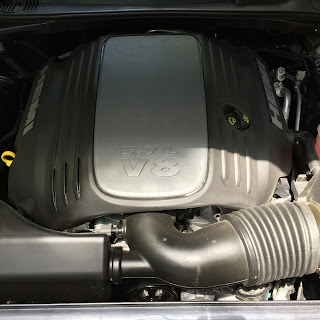
The 5.7l Hemi V8 Engine
My hire car is the automatic variant, which I understand to be an 8 speed. It's fairly responsive and seems perfectly good enough for the engine by American car standards. I don't know the specs for sure, but I bet this is a single clutch system. I'm lucky in that my own car at home, the Audi A4, has the S-Tronic system and obviously the dual clutch system on the S-Tronic gives it a big advantage. Compared to typical American hire car fare, however, the automatic clutch on the Challenger is definitely man enough.

Muscle car fans probably won't agree with my next statement however. Although the power of the Challenger made me laugh with pleasure every time I put my foot down, I still couldn't shake a feeling that it didn't quite have the same sense of urgency even as my own car. And this is where I think there is a key difference in the typical European sports car vs the American muscle car. For all of the Challenger's power, it is only 0.7 seconds quicker to 60 than my 250bhp A4. Once you start to look a bit deeper I think it becomes obvious why. In the Dodge Challenger you have 375 hp going through the rear wheels in a 2000kg car. In my A4 you have 250bhp going through 4 wheels in a 1350kg car. Even if you just look at the power to weight ratio you have 0.1875hp/kg in the Dodge and 0.1852bhp/kg in the Audi. That's not much of a difference, and if you consider that with Quattro you are getting power to all 4 wheels from a standing start, this is why I think the Challenger ultimately lacks that urgency and that "shoving you in the back of the seat" feeling you might expect with all that power.

The American muscle car is a frickin huge, powerful and heavy engine with just enough car round it to enjoy it. The European (or rather German) sports car is all about engineering, and that engineering largely gets you to the same place as the muscle car but with half the fuel consumption.

I know muscle car fans will probably not like the comparison and in a way it isn't fair, because really it is comparing apples to oranges. I do not mean to be negative about the Dodge Challenger at all, it was absolutely thrilling driving it for a week, but nonetheless that feeling about the lack of urgency despite all that power was there and I'm just trying to articulate why I think that is.

So, moving onto other points...

The Exterior


The outside of the car looks great, it says American muscle car all over it. Aggressive styling from the front and rear, great looking rear light clusters, excellent side profile with obviously only 2 doors, this being a coupe. The car certainly looks the part from the outside and goes well with the engine sound. There's certainly no comparison to the (in)famously fairly modest looking Audi in the looks department (even though actually I love how my Audi looks, especially the rear lights).

The Interior


The stereo  and integrated controls, pretty poor.
Taking a serious look at the interior of the Challenger reinforces the ethos with cars of this type. The interior is quite sparse. The upholstery and quality of the fabric is fine, but there is no leather in sight. Even the steering wheel, whilst comfortable, is a poor fake-leather/rubbery type material. Looking at the Dodge website, leather doesn't even seem to be an option, I think that is quite a poor show for what is essentially meant to be a car you impress your friends with. Why wouldn't you want to add a harder wearing and better looking leather interior to go with all that muscle?

I could write pages about my feelings on the Dodge interior, so let's break this down into pros and cons:

Pros:
  • Almost fully electric seats with adjustable back support. Electric windows and mirror adjustment.
  • Keyless entry and engine start/stop.
  • Having a touchscreen display in the centre console is a nice touch.
  • Driver's dashboard, whilst basic, does fit in with the sportiness of the car and it also partially features an electronic display.
  • The car does appear to have some kind of stability program, although I'm not sure if it is only ABS or if it includes traction control (having successfully had the wheels squealing during my second day in the car).
Keyless entry is a nice feature, however.
Cons:
  • The seats have a manual fix/loose lever you open and close to adjust back tilt. Bizarre when all other seat controls are electric.
  • Too many controls centralised on the touchscreen digital display and the stereo/control system itself frankly rubbish. In particular I don't like the way half of the AC controls are only accessible from the touch screen.
  • The driver's dashboard is basic. An analog and digital speedo, rev counter, engine temperature and fuel gauge, and that's it. Quite the comedown when you are used to Audi's Virtual Cockpit.
  • No leather interior option.
The stereo system and a lot of in-car controls are centralised on the touchscreen display. Frankly, it is a really poor and basic system. It pesters you with a pop-up message you have to say OK to every time you start the car (although that may be normal with American cars). I paired my phone to the stereo but it never remembers to use Bluetooth when you turn the car and on always switches back to radio. Half of the AC controls are on this touch-screen system and the other half are traditional dials. The display is too small and difficult to use when driving (even with sensible use such as when you are stopped at lights), although you can upgrade to a bigger display with more features as an optional extra.

Really, the interior does tell a story about the price you pay when buying an American muscle car, on top of the actual price of course. Essentially you are buying the 5.7l v8 engine and only enough car around it to enjoy using that engine, there is precious little on top in terms of toys. Keyless entry is a nice plus you might not expect, but a lack of any toys, even as additional extras, are huge negatives, and seems like a missed opportunity from Dodge. On the other hand, the car already weighs 2 metric tons, so maybe putting even more toys in it isn't the answer.

The Price


So, by looking at the features that are obvious (or rather the lack of them) and using Dodge's "Build & Price" feature on their website, I calculate that the car I have costs $34,840 brand new, which is £26,842 at the time of writing. That is quite a bit of money for a fantastic engine in a good looking but functionally basic car. You could spend that much money on a European car and get a top of the range model of a non-premium-brand car with a decent engine, although nothing like the v8 of course, and without four wheel drive you're not going to get close to the acceleration from standing either, so ultimately there is nothing comparable in the UK market that is "better."

Summary


Ultimately, the American Muscle car is not about having something that makes sense on paper, because they don't make any sense at all on paper. Heavier, thirstier, somewhat expensive and ultimately a fairly basic car with the old-school muscle engine in it.

But my god is it fantastic to drive!

And that sums it up, if you just look at the specs on paper and considering technical engineering points as a basis for reviewing the Dodge Challenger, you've missed the point (I know I've done that but only to try and articulate my thoughts). Driving a muscle car isn't about making sense, it's about having muscle and putting rubber down on the road, and it's as simple as that, and it's f*****g fantastic!

If I could get to drive a Dodge Challenger or another manufacturer's muscle car again in the future then I'd totally go for it!

I'm not sure I could own one as my everyday car though.

Monday, 29 May 2017

How to Watch 3D Movies in VR (HTC Vive / Oculus Rift)

Hello blog fans,

This week we have a practical blog post on how you can watch your 3D Blu Ray movies on your VR headset. This one will work on HTC Vive and Oculus Rift.

The main reason I'm writing this post is because I scoured the internet trying to work how to do this. I was trying out loads of different movie players including VLC, Media Player Classic, Stereoscopic Player, DeoPlayer, Vive Cinema and loads of different ripping and transcoding software including Brorsoft, DVDFab, Handbrake, MakeMKV, etc...

In the end, the solution I found is relatively simple, although a little time consuming. But more importantly, I did not find this method anywhere on the Internet, it is a lot less complicated and cheaper than most of them and some of them didn't even work for me! Believe me, I must have looked in a hundred different places and not one of them highlighted this particular method.

This solution is better than any of the others I have found on the internet in that
  1. It actually works, and the only other methods that worked for me are ones that required expensive re-encoding software.
  2. It is cheaper than most, if not all, of the other methods. Stereoscopic Player is cheaper at 49 EUR than the non-free video encoders that other methods use to convert MVC 3D movies into SBS (Side by Side) format.
  3. It is quicker. Although you need to spend an hour ripping the movie off the Blu Ray, you have to do that anyway. Unlike other methods, this way of playing your movies does not require you to re-encode your movies, and this will save you having to wait another 4+ hours after you have ripped the movie.

So what better blog post to make then a new and simple way to watch your 3D Blu Rays on your VR headset!

Step 1 - Get the Software


You need 3 free bits of software to watch your Blu Rays on your VR headset.
  1. MakeMKV (with beta key here)
  2. Stereoscopic Player
  3. Bigscreen Beta on Steam.
A few words about these applications.
  1. The whole time I've known of MakeMKV is that it is free whilst it is in Beta, which is forever so far. All you need to make sure you do is get and register the latest beta key, because they expire every month.
  2. Stereoscopic Player is only free for 30 days, after that you you do need to buy a registration key. This software provides the magic sauce over other so-called howtos on playing 3D Blu Rays in VR, because it can play MVC 3D titles, no need to convert your Blu Rays to SBS. If anyone finds a free way to play MVC 3D movies as SBS output then let me know!
  3. Bigscreen Beta takes Stereoscopic Player and presents it in full 3D in your own VR movie theatre, it looks great!

Step 2 - Rip the Blu Ray


Unfortunately, because Blu Rays are encrypted, Stereoscopic Player can't play straight off the disc, so you need to use MakeMKV to do a straight rip of the movie to your hard drive.
  1. Run MakeMKV and put the Blu Ray in the drive. Once the drive recognises the disc, press the large Blu-Ray Disc icon on MakeMKV to open the Blu Ray.
  2. Now MakeMKV will present you with a lots of options of what to rip. The Blu Ray disc may have multiple titles, in which case make sure you are working with the biggest one in size, as this will be the main movie. I recommend you expand all the arrows so you can be very clear about what you are choosing to rip.
  3. You need to make sure you tick the MVC-3D box for Video under the standard Mpeg4 Video line, otherwise you will only rip the video for the left-eye, the MVC track contains the right-eye video. Also, select an audio track, it's up to you but I tend to go for the 7.1 Surround option for best possible audio.
  4. Then you can pretty much untick everything else, although you can of course choose other language soundtracks or subtitles if you want.
  5. With everything correctly ticked or unticked, proceed to rip the movie by clicking on the MakeMKV button on the right-side of the application.
Once you click the button, then you come across the only downside to this method because it takes around an hour to rip the movie to the hard drive so you can play it. If anyone can find a method where you can play an MVC movie straight off a Blu Ray disc then let me know!

Step 3 - Play the Movie in SBS Mode


The reason we don't have to convert the movie to SBS (or Side-By-Side) mode, is because Stereoscopic player will take an MVC 3D encoded movie as input and play it as SBS on output. Playing the movie in SBS mode is what allows Bigscreen to show it in 3D.
  1. Ignore the option "Open Left and Right File" because this is for when you have a seperate movie file for the left eye and one for the right eye. Actually, on the Blu Ray itself they are seperate files, but we merged them together when we ripped with MakeMKV. So just chose the regular "Open File" option to open your movie.
  2. With the default options, the movie will play as an analgyph picture. This is when you have different coloured images for left eye and right eye and you need those old fashioned blue and red 3d glasses to watch them. We don't want to watch the movie like this, so go into File → Settings.
  3. Select "Playback Options" and change "Viewing Method" to "Side by Side for 3D-TVs". When you click OK, you will see 2 images appear side by side. They will look stretched but this is okay, because BigScreen needs the image this way so it looks properly on your headset.

Step 4 - Run BigScreen and Select SBS Mode


Here's the final piece of the puzzle, Bigscreen can take SBS video on your desktop and play it as 3D in your bigscreen virtual movie theatre.

With the movie playing in SBS mode, run BigScreen and put on your headset. Use the controller to select the screen icon on the Bigscreen control panel, that says "Customise your screen" when you point at it. Then select SBS. Et voila, you should see the movie playing in 3D on the big screen in front of you.

If you are still in the default room in Bigscreen, which is the lounge, I recommend changing it to the next room in the list, which is the home theatre room. This is the ideal way to watch the movie in your headset.

Result!


So there we are, how to watch your 3D Blu Rays in VR. Unfortunately you do need to rip the disc, which takes an hour, but you don't need to convert it, which would probably take another 4!

Don't forget to delete the movie when you are finished, because you are probably using 40GB of space for a typical 3D movie. :)

Enjoy!

Sunday, 7 May 2017

The Horror Genre in VR

Hello VR seekers,

VR seems to especially fire the imagination in some areas. To be frank, porn is one of them. No great surprise there I guess but this isn't something I'll be writing about at any time.

I mention porn, only because in the film world, I use that word with another entire movie genre, the horror movie!

Talking About Horror


The Thing - one of the all-time classics
I'm not a big fan of horror movies because I feel most movies are really horror porn. What I do mean? Well, I mean the plot is thin, the story is generally unbelievable and you get entire movies which are totally derived and only exist as a platform to try and scare or gross you out.

That's not to say there aren't good horror movies out there, but for me it is mainly restricted to some classics: Films like Alien and The Thing, these are movies that are really good in their own right and they just happen to scare or horrify as well. There are other movies I like as well, such as some of the old Hammer Horror movies, but they are so old that, from a point of view of causing scares, they are lame by today's standards. You don't watch the really old films any more because you want to be scared.

I find Nightmare on Elm Street is okay, but here we are already slipping back to the horror porn genre, with the likes of Hellraiser and Friday the 13th. The original Poltergeist is okay but it is an anomaly for me, there is something unique about that movie that turned it into the cult classic it is.

Why am I telling you all this? I want to give you the context for how I feel about horror in general because it's really important to understand where I am coming from when it comes to horror in VR.

Horror in VR


I must admit, I haven't tried a great deal, in particular I am still restricting myself to the free samples out there, but I do have an ambition to buy Resident Evil 7 VR when it hopefully comes to the PC in 2018 and that ambition is boosted by my experiences so far.. and that is coming from someone who is not a big fan of horror in general. You can probably start to sense where the rest of this blog post is going.....

So I tried the following 2 very short horror games, both available on Steam.
The monk in The Abbot's Book
The Abbot's Book professes to be a snippet of a much larger 8 episode game, with a snippet of the 7th episode forming the demo. That's great, but there's precious little information about when the full game (or even episode 1) is going to come out, but that doesn't matter. The setting for the game is the role of an Italian aristocrat who owns an estate associated with a myth about an old evil God. In the demo you play said aristocrat as he is about to go down into catacombs that run under his estate, bringing with you some local monk who apparently believes none of it.

The Bellows doesn't really explain much about the setting. You wake up in a dark room and start off by looking out a window, which immediately gives you the impression you are in some kind of large building like a mansion. Then as you start creeping through the place you realise you are in what looks like an old asylum.

To be honest, the settings don't really make difference to my review. There are a lot of parallels between both games. Similarities are as follows.
  • You are defenseless
  • You are limited to moving around quite slowly
  • Both games are very moodily lit with infrequent light sources and lots of dark corners
What are the differences?
  • The Abbot's Book is a bit more sophisticated than The Bellows in that you have another character following you around, the monk. This character forms a typical mechanic in movies, which is the unbeliever or the innocent or ignorant party. He basically allows another person to explain to him what is going on, which of course fills in the viewer at the same time.
  • The other cool addition to Abbot's Book is that it is actually your character that fills in the monk, you hear yourself talking to the monk, explaining things to him, and the game gives you the chance to tailor your replies with some simple options.
  • Another difference between the 2 games is that The Abbot's Book relies on a slow-operating blink system for movement (i.e. teleportation) and The Bellows gives you free direct (and slow) movement.

So Where is This Going?


Fancy having a face-off with this fellow do you?
The 2 final similarities between the 2 games sum up my feelings on the Horror genre in VR.

Firstly, both of these games are filled with very old school tried cliches of horror. Things flying around on their own, dark corners with hints of movement, images appearing and then suddenly disappearing, things suddenly moving next to you with sudden sound effects designed to make you jump. Really, if you watching a movie rather than playing in VR, you'd be thinking this is tired old crap and turning it off.

So the second similarity, the VR experience turns the tired old cliches on the head, because you are actually there! Some of the mechanics are still quite tame, flying furniture gets old really quickly, but the slow moving around, the dark corners everywhere, the really odd sounds you hear behind you... These tired old cliches take new life in VR.....

Because you are right there in it all. There's no hiding behind the couch here, there's no respite from the suspense, that dark corner or room you can see, or rather can't see anything in? Yeah, you've got to walk into that. It's quiet different having a pitch black view on a TV then having pitch black all around you, whilst you are waiting for what happens next.

The biggest, BIGGEST frights I got, were the ones where you are being approached by a malevolent character. In one experience, there is a character you see throughout the game doing really horrible stuff, this character keeps appearing again and again, and at one stage he comes for you. You are there paralysed in fright whilst he moves purposely towards you. That one is quite the hair raiser. In the absolute biggest frightener however, there is a moment when this human-like figure with a mutant face jumps out from nowhere and right in your face, so you turn away and HE IS STILL RIGHT THERE IN FRONT OF YOU, YOU STEP AND LEAN BACK, REELING AWAY BUT HE IS STILL RIGHT THERE. Then he disappears and you breathe a massive sigh of relief. As someone who doesn't scare that easily, I have to say this one really got my heart racing.

Horror Movies and Horror VR - Not the Same!


So this is why the film review at the start was so important. When it comes to horror in the movies, a lot of it is plot-thin tired old cliches. In VR, however, none of that matters. It doesn't matter if you think you know what happens next, because it is you in this place, not some movie character on a screen.

I'm a VR horror believer. This is why I'm keen to try Resident Evil 7. This is why I'm now going to be looking at other horror VR experiences! If you have a VR headset and you haven't tried out these games yet, you need to do so or you are missing out.

Maybe don't try them if you have a heart condition though.